
Yes, you can DIY, but the “invisible line” lies between Clip-ins and Bonds. For beginners in the U.S. market, home extensions are a high-reward game for volume, but a high-risk gamble for hair health if you touch glues or beads without professional training.
Table of Contents
The Great Debate: Should Beginners Really Attempt DIY Hair Extensions?
Watching a salon invoice climb toward $1,000 for a full head of extensions is enough to make anyone hit “Add to Cart” on a $150 DIY kit. But after managing thousands of hair restoration cases at our upladys U.S. studio, I’ve seen the aftermath of these “5-minute transformations.”
The truth? DIY isn’t a binary “yes” or “no.” It’s about knowing if your manual dexterity matches your aesthetic goals. We’re moving past the era of “faking it”—American consumers now demand extensions that survive a HIIT session at SoulCycle or a windy rooftop brunch in NYC. If you choose the wrong method, you’re not just saving money; you’re risking your natural follicle integrity.
The Surge of DIY Extensions in the U.S.: Real-World Trends
The DIY extension surge in the States is driven by “Dupe Culture” and the rising cost of professional labor. Based on our internal upladys studio observations and tracking of U.S. social commerce trends through 2025-2026, over half of women aged 18-35 have experimented with non-permanent home kits.
| Metric | DIY Home Kits | Professional Salon Service |
| Initial Cost | $50 – $200 | $600 – $1,500+ |
| Success Rate (First-timer) | ~40% (Natural blending) | 99% (Seamless integration) |
| Primary Driver | Cost-saving (72%) | Longevity & Safety (88%) |
| Risk Factor | High (Traction & Breakage) | Negligible (Professional prep) |
“The influx of ‘TikTok-made-me-do-it’ hair trauma in our clinic is real,” notes our senior stylist. Most beginners underestimate the tension required. According to the American Academy of Dermatology (AAD), improper tension from extensions is a leading cause of Traction Alopecia, a form of hair loss that can become permanent if the scarring of the follicle occurs.
The Authentic Advantages: Why DIY Appeals to the Modern Consumer
1. Erasing the “Salon Tax”
The math is undeniable. In major U.S. hubs, you aren’t just paying for hair; you’re paying for the stylist’s chair rent and years of education. DIY allows you to bypass the 60-70% labor markup. If you’re just looking for “weekend hair” for a wedding or a photoshoot, the DIY route is the most logical financial move.
2. Social Privacy and Zero Pressure
I’ve had many clients tell me they feel “stylist anxiety”—the pressure to chat for three hours or the fear of being judged for their natural hair thinning. At home, it’s just you and your mirror. You can take your time to perfect one section without the social exhaustion of a busy salon environment.
3. Total Aesthetic Sovereignty
In a salon, you’re often limited to the brands that the stylist carries. DIY opens up the entire global market. You decide exactly where that extra volume goes. Want a subtle “money piece” highlight without the chemical damage of bleach? You have the control.
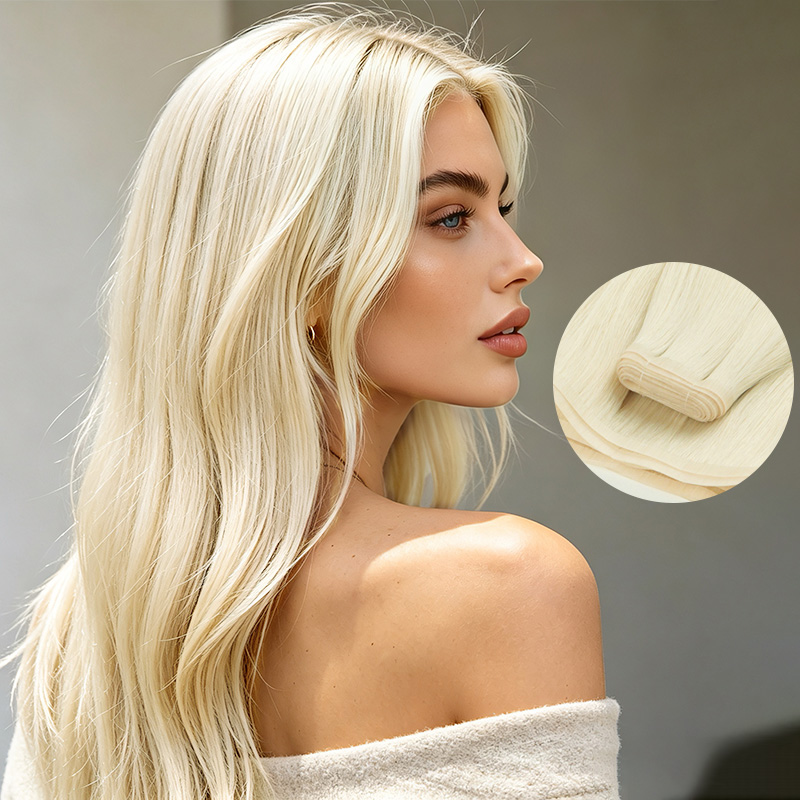
The Hidden Risks: Where Beginners Typically “Fail”
1. The “Shelf” Effect: The Dead Giveaway
The most common “fail” we see is the harsh horizontal line where the natural hair ends and the extension begins. Without professional blending shears and the “tapering” technique, DIY extensions often look like a heavy curtain hanging under a bowl cut. It’s an immediate social giveaway.
2. The Invisible Scent and Scalp Tension
Low-quality DIY adhesives often carry a distinct chemical “glue smell” that lingers, especially when dampened by sweat. Furthermore, beginners rarely understand “distributive tension.” Medical studies on hair fiber stress indicate that exceeding the load-bearing capacity of a single hair shaft leads to immediate breakage at the root.
3. The Complexity of the Nape and Crown
Self-sectioning the back of your head is an athletic feat. Most DIYers end up with crooked tracks in the “blind spot” of the nape, which become visible the moment you put your hair in a ponytail or even a simple claw clip.
Beginner-Friendly Methods (Low Risk / High Success)
If you are going to do this yourself, stick to these “Safe Zones” we recommend at upladys:
- Clip-In Extensions (The Gold Standard): These are the only truly “zero-risk” DIY options. They use mechanical pressure rather than chemical bonds. Pro Tip: Back-comb your roots slightly before clipping to create a “shelf” that prevents sliding.
- Halo/Wire Extensions: Perfect for those with thin hair who fear clips. It sits on the head like a headband, using the weight of your own hair to stay secure. It’s a one-step transformation.
- Temporary Volumizing Tabs: Smaller, lightweight wefts designed for 24-48 hour wear. Ensure you use hypoallergenic medical tapes to avoid contact dermatitis on the scalp.
Professional-Only Methods (High Risk / Avoid at Home)
Avoid these unless you want to end up in a “Correction Appointment” that costs double the original price:
- Keratin Bonds (K-Tips): Melting protein near your scalp at high temperatures is a recipe for third-degree burns and “matted nests” that require surgical-grade removal.
- Sew-Ins/Weaves: The tension required for the foundation braid must be exact. Too tight, and you risk permanent follicle death from the sheer weight.
- Micro-Links/I-Tips: One wrong squeeze of the pliers and you’ve sliced through your natural hair shaft.
DIY vs. Professional Salon: A Comparative Breakdown
| Feature | The DIY Route | The upladys Salon Experience |
| Material Quality | Often mixed fiber or low-grade Remy | Hospital-grade, Ethically Sourced 10A+ Human Hair |
| Scalp Health | Trial and error (high risk) | Custom tension mapping to protect follicles |
| Natural Blending | Visual “Shelf” common | 3D Color matching and texturizing |
The 3 Most Common Beginner Blunders
- Placement Too High: Clips should never be above the “eyebrow line.” If they are, a light breeze will expose your secret instantly.
- Ignoring Texture Match: Putting silky European-texture clips into textured or coarse hair is the fastest way to look like you’re wearing a costume.
- Rough Removal: More hair is lost during the take-down than the install. Never pull or rip. Use proper oil-based removers for any adhesive-based DIYs.
The Essential DIY Toolkit for Newcomers
- Professional Rattail Comb: For surgical-grade, straight sectioning.
- Duckbill Clips: To hold back the “bulk” of your hair while you work the lower layers.
- Silicon-Lined Wefts: To provide grip without stripping the hair cuticle.
- LED Triple-Fold Mirror: Because you cannot blend what you cannot see.
Who Should DIY and Who Should Book a Stylist?
You are a DIY Candidate if: You have a steady hand, your hair is already shoulder-length, and you only want extensions for specific events or weekend wear.
You MUST see a Stylist if: You have active hair thinning, your hair is shorter than 4 inches, or you want a “wake up like this” look that lasts for months without daily maintenance.
Frequently Asked Questions (FAQ)
Can I sleep in DIY extensions without damaging my natural hair?
Strictly speaking, it depends on the attachment method, but for the vast majority of DIYers using clips or halos, the answer is a firm never. Sleeping in clip-ins causes the metal or plastic teeth to press into your scalp for 8 hours, which can lead to localized inflammation or “pressure sores.” More importantly, the friction between your pillow and the extensions creates “nesting”—a severe type of matting at the root that often requires professional intervention to de-tangle without cutting your natural hair. If you are using temporary tape-ins, we recommend a silk pillowcase and securing your hair in a loose, low braid to minimize mechanical stress on the follicles.
What is the “Secret Sauce” to preventing extensions from falling out in public?
The nightmare of a track sliding out during a date is usually caused by “slick roots.” At upladys, we teach the Anchor Method: before applying any DIY weft, spray a hit of dry shampoo or texturizing spray specifically at the root where the clip will sit. This creates “grit” and friction. For those with ultra-fine or “slippery” hair, use a rattail comb to lightly back-comb (tease) a tiny 1-inch horizontal shelf of hair at the base. Clipping the extension into this teased “nest” provides a mechanical lock that ensures the hair stays put, even through high-intensity movement or wind.
How do I choose the right weight (grams) so it doesn’t look like I’m wearing a “helmet”?
Many beginners make the mistake of buying the heaviest set available, thinking “more is better.” In reality, matching the density of your natural hair is the key to a seamless blend. If you have fine hair and apply a 200g “Mega Volume” set, the weight will pull on your scalp (causing pain) and the transition will be impossible to hide. A professional rule of thumb: if your hair is thin, stay between 100g-120g; for medium-to-thick hair, 150g-180g is the “Sweet Spot” for U.S. styles. You want the extensions to move with your hair, not hang like a heavy, immobile curtain behind it.
Will DIY extensions cause my natural hair to stop growing or fall out?
This is the most common anxiety in our U.S. studios. DIY extensions themselves don’t stop hair growth, but improper tension does. When you DIY, you lack the “tactile feedback” a stylist has when measuring how much weight a single section of hair can bear. If you feel a constant “pinching” or “sharp tugging” sensation, that is your scalp signaling that the hair is being pulled past its elastic limit. This leads to Traction Alopecia. To keep your natural growth cycle healthy, always take breaks—never wear DIY extensions for more than 12 hours at a time, and never apply them to wet or damp hair, as the hair shaft is weakest when swollen with water.
How can I tell if a DIY kit is high-quality or just “expensive plastic”?
Don’t be fooled by “Silky Smooth” marketing. Many cheap DIY sets are coated in high-gloss silicone to feel soft in the box, but after one wash, that coating disappears, leaving you with a tangled, matted mess. To test for 10A+ Human Hair quality, look at the ends. Real hair is naturally slightly tapered and has subtle color dimensions; if the hair is the exact same thickness from top to bottom and has a “mirror-like” artificial shine, it’s likely a synthetic blend. At upladys, we always recommend the “Heat Test”: high-quality human hair will withstand a 350°F curling iron without a chemical smell, whereas synthetic blends will emit a faint “burnt plastic” odor and lose their texture immediately.
Final Verdict: Can You Truly DIY Your Hair?
You can certainly achieve a “good enough” look at home for a fraction of the price, provided you respect the limits of your hair’s biology. Stick to Clip-ins and Halos. But if you’re chasing that seamless, “is-that-her-real-hair?” perfection—especially for the long term—there is no substitute for a professional’s touch. Don’t let a $100 DIY kit turn into a $2,000 hair restoration nightmare.
For a complete guide on this topic, explore our [Hair Extensions 101: The Ultimate Beginner’s Guide]